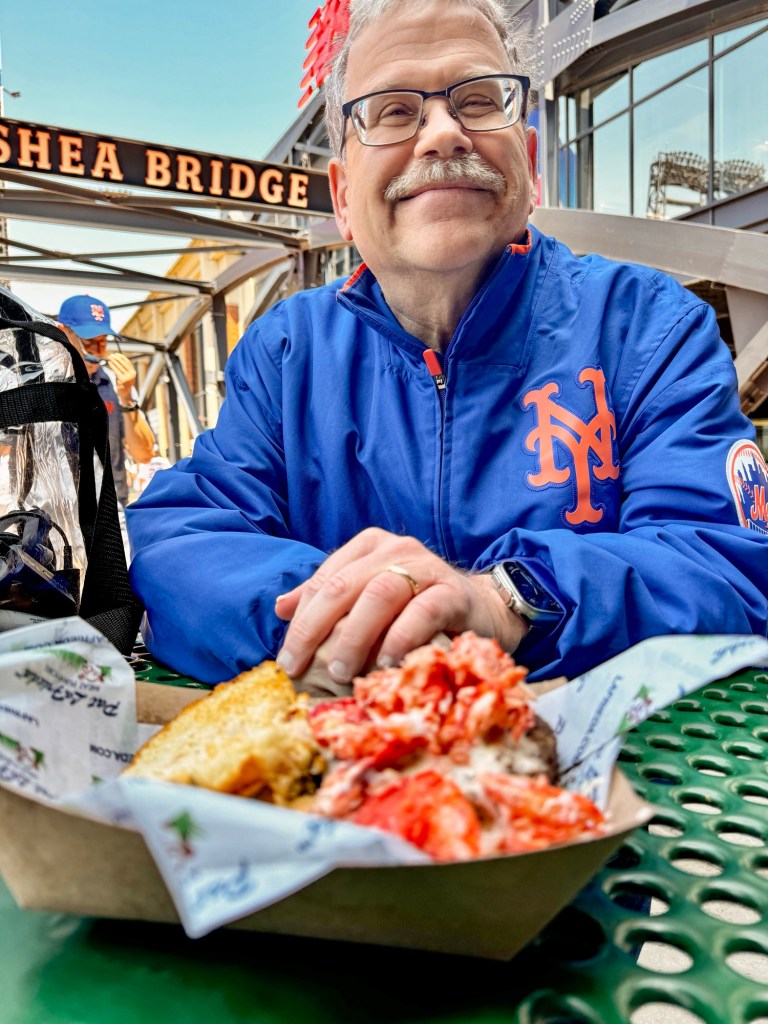
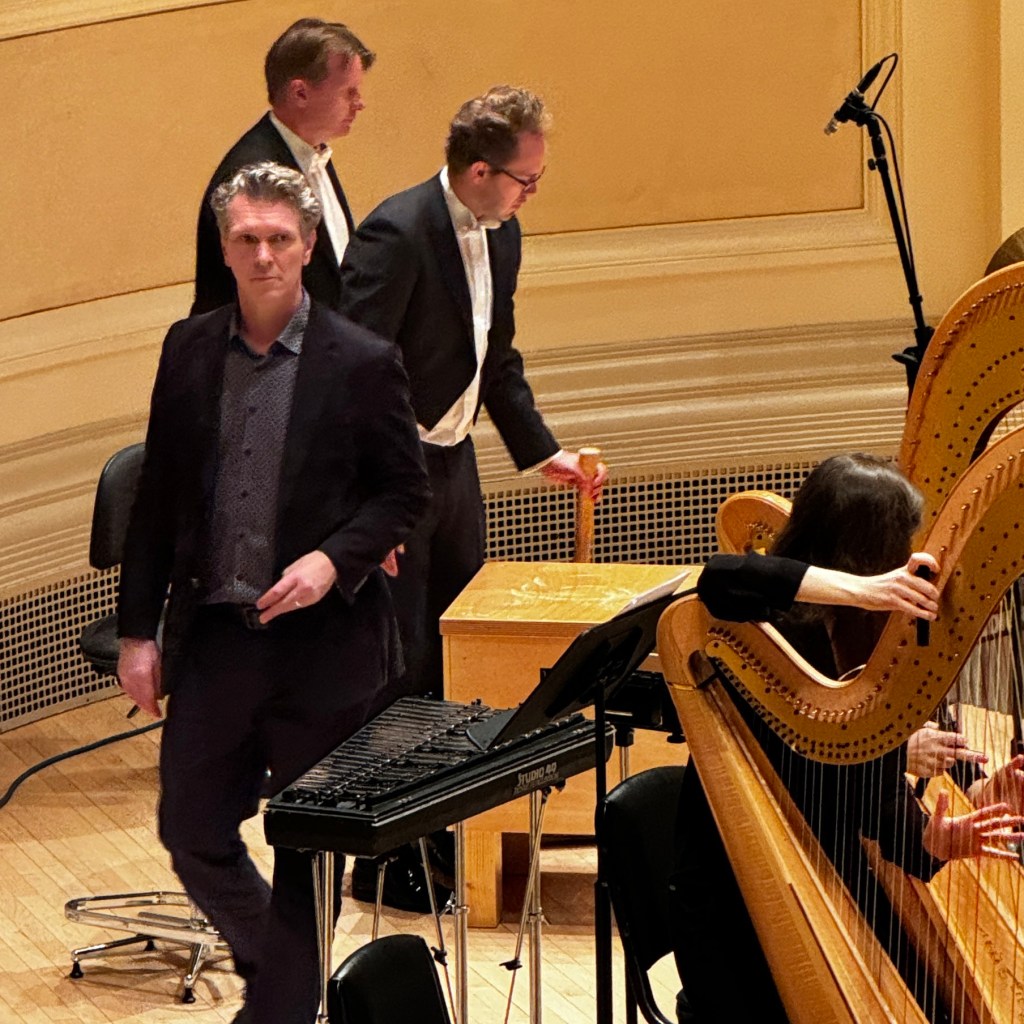
Pat La Freida’s Chanpion BurgerThai iced tea with bubbles!When your big moment comes in the last movement of Mahler’s Sixth Symphony and involves raising a giant hammer over your head with two hands and forcefully slamming it on a resonant wooden box at several climactic moments, you nervously check that your mallet is there at intermission.
Numerous times.
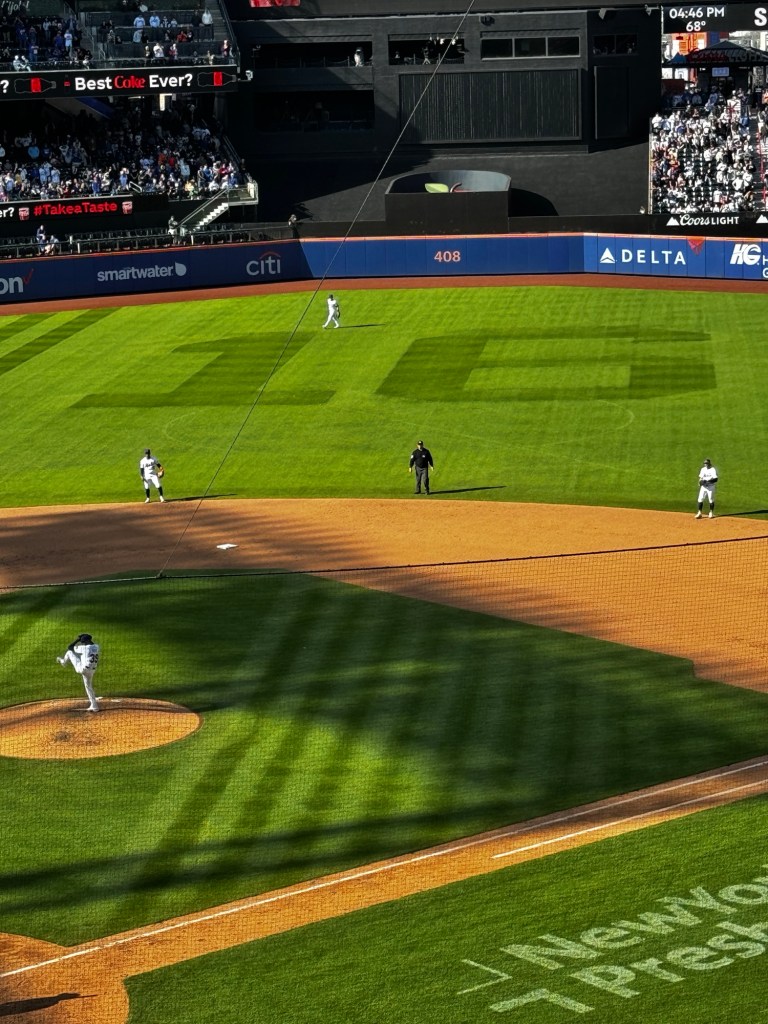
Warm, gorgeous weather—afternoon game. Shopping City Connect merch and trying lobster-topped burger and bubble tea. Mets lead through six, we depart. To Carnegie we go for Mahler VI.
Shut out through eight and tantalized by two on, almost-walk off in ninth. Decree from Chelsea resounds, “No block at plate.” Cameras provide no succor. Stunned, silenced park. It’s over. Pete is out.
Bluster and chill returned to the park
amid feverish demand for
Seymour Weiner and dollar
hot dogs. Teams tied at 1
for many innings.
Seeking warmth, we
left after
Stewart’s
bomb.
The ballpark had thawed—a flawless night.
Innings passed expeditiously.
Severino near perfect.
In eighth, no-no nixed by
former Brave Swanson.
Downward spiral
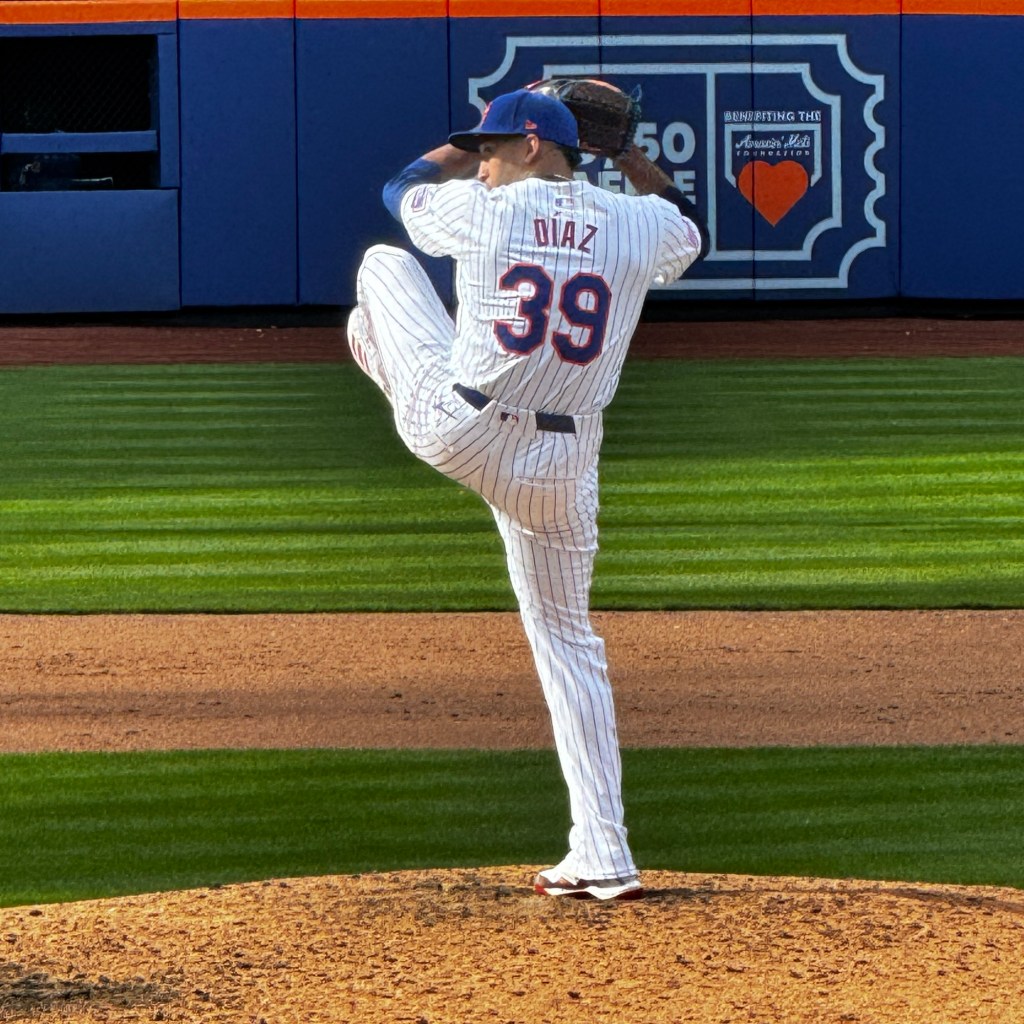
saw Diaz
earn the
loss.
A Mets starter going eight innings?
Quintana’s efforts saved the pen.
Lindor homered in the sixth,
but after that:  crickets.
But the eleventh?
A timely hit
plus homer:
Walk off
win!
The day’s promotional giveaway: a Harry Potter scarf.
GAME 14 – April 27, 2024
Hogwarts Houses could not magic bring
to Mets defense. Sorcery of
Cards’ bats cast spell on starter.
Houser’s witchcraft earned six.
Wizardry of Pete
conjured home run
two hundred.
Milestone
reached.
Leaving San Francisco with their hearts
.500 record on the road
Balmy Midwest temperatures
St Louis did not bring.
J. D. Martinez
debuted, hit two.
Helsley’s heat
shut the
door.
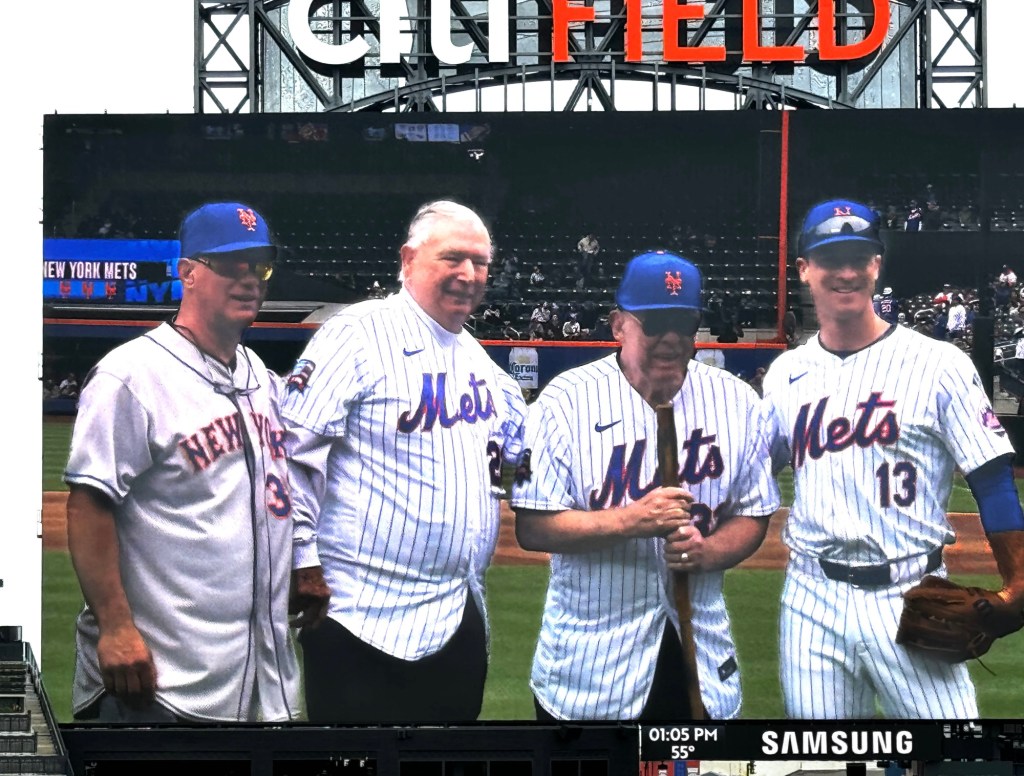
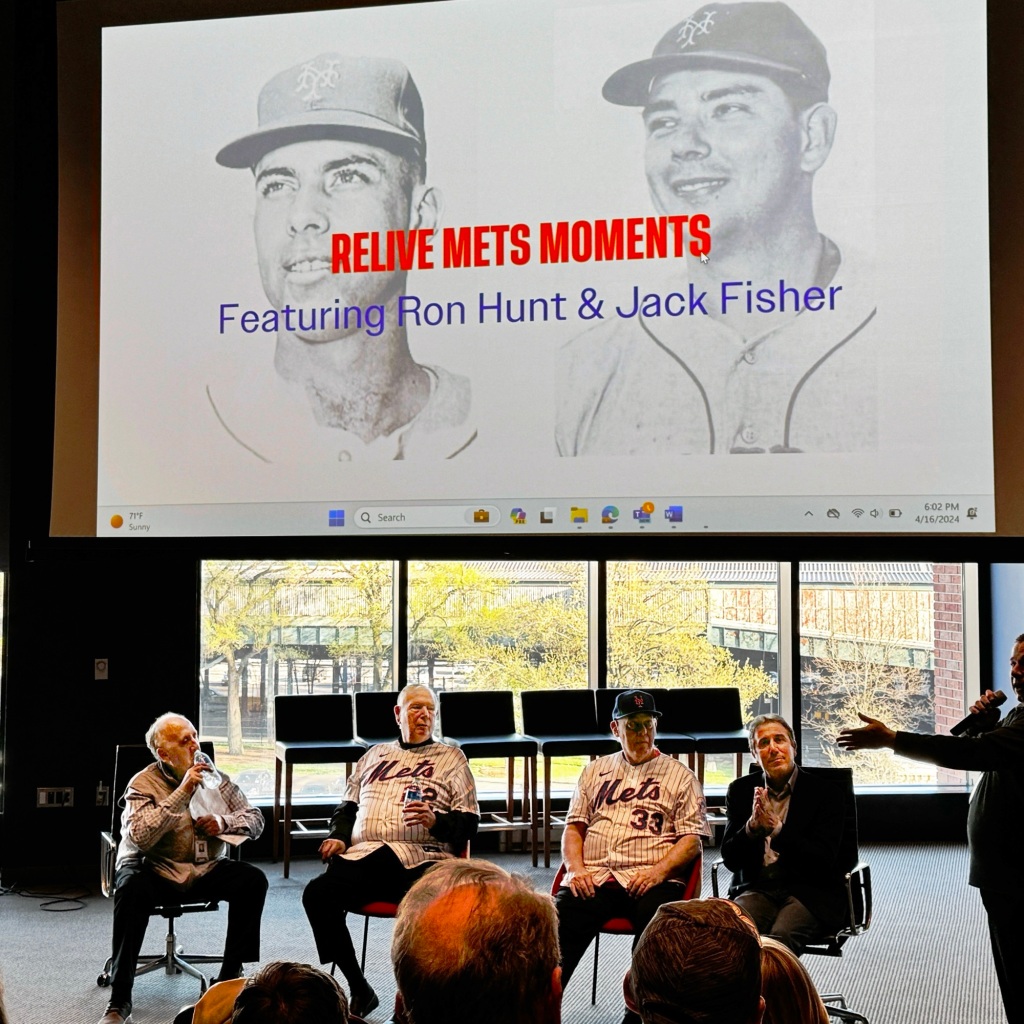
“State of the Art” is how Jack Fisher
described brand new Shea Stadium.
First to take its mound sixty
years ago today, he
and second-baseman
that day, Ron Hunt,
returned and
took the
field.
Among the first to play at Shea, they
talked of Casey Stengel, losing
seasons, getting plunked, and the
first All-Star Game in Queens.
Recollections from
sixty years past,
but vivid
in their
minds.
Carlos Mendoza, Butch Husky, and Mookie Wilson present flowers to Rachel Robinson prior to the game—seventy-seven years to the day her husband, Jackie Robinson, broke baseball’s color barrier.
GAME 10 – April 15, 2024
Rampant stealing surprised Mets fans and
Pirates alike.  An homage to
Jackie on his day?  Color
barrier broken so
many years ago.
One hundred one,
Rachel is
still with
us!
His number now gleams above the park,
adorning a jersey no more.
Doc’s happy return seemed to
inspire pitchers du jour.
Today’s K Korner
totaled fourteen.
Fine pitching
ruled the
day.
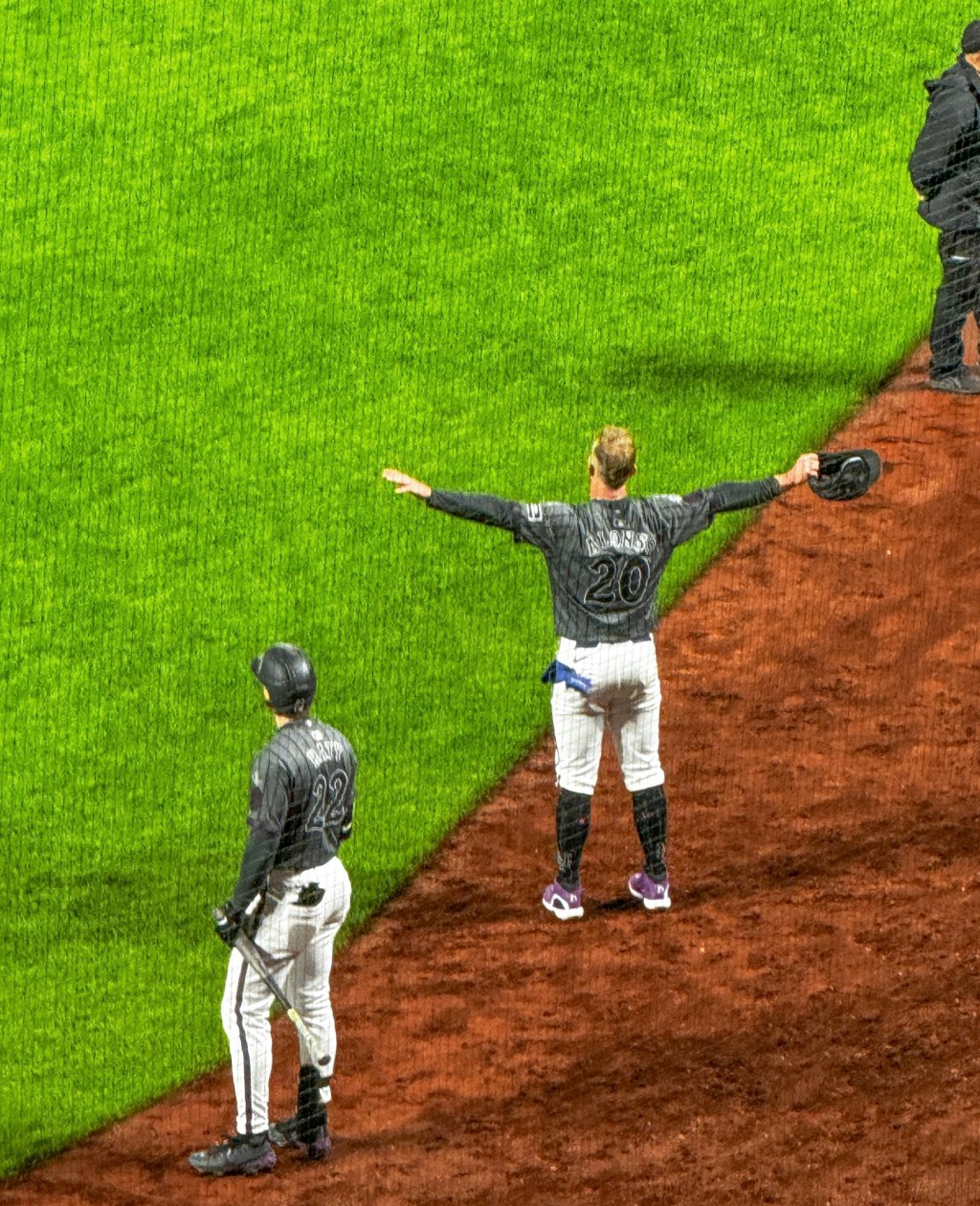
Pete Alonzo’s sixth-inning home run: his second of the game.
GAME 8 – April 13, 2024
Hot Mets bats meet K.C. inferno. Marte errs, Nimmo helps a ball scale outfield wall: all costly. Seats near field afforded view of Alonzo crossing the plate: he homers not once. Twice!
Resuscitated on the road, the offense returned home with the team. Baty’s bat and defense proved especiallly welcome. An uplifting sight: his confidence, new-found, as was his smile.
Fourteen scoreless innings and cold temps meant even fewer fans in the stands for the second game of the doubleheader, but those that remained were rewarded with a feel-good walkoff win.
Tahlequah native Houser did my hometown proud in his Mets debut. The Mets scored three, Detroit tied in the eighth, another Mets loss in extras. Record now stands at Oh-and- five. They’re sad.
Gastronome Canha returned to cheers. Starter Manaea’s grand outing went for naught. Mets were shut out. First game at night featured splendid light display. But ‘twas a loss at the end of the day.
The hot cocoa machine had been fixed: one win. A paucity of hits mirrored an apparent dearth of shrewd ideas for between-innings games: blind-folded fans name cheeses by their smell?!
Looking for the good in a dispiriting day and series with the Brewers, upon exiting the ballpark, we reflected on great Mets pitching moments in history that had happened here.
We also reminded ourselves that at least the hot chocolate maker in the Piazza Club had worked today.
Alvarez, Alonzo, and Baty go long and make it a game, and Dìaz returns with brass band. Fans embolden Hoskins. Seven rows from field courtesy of VIP of a friend.
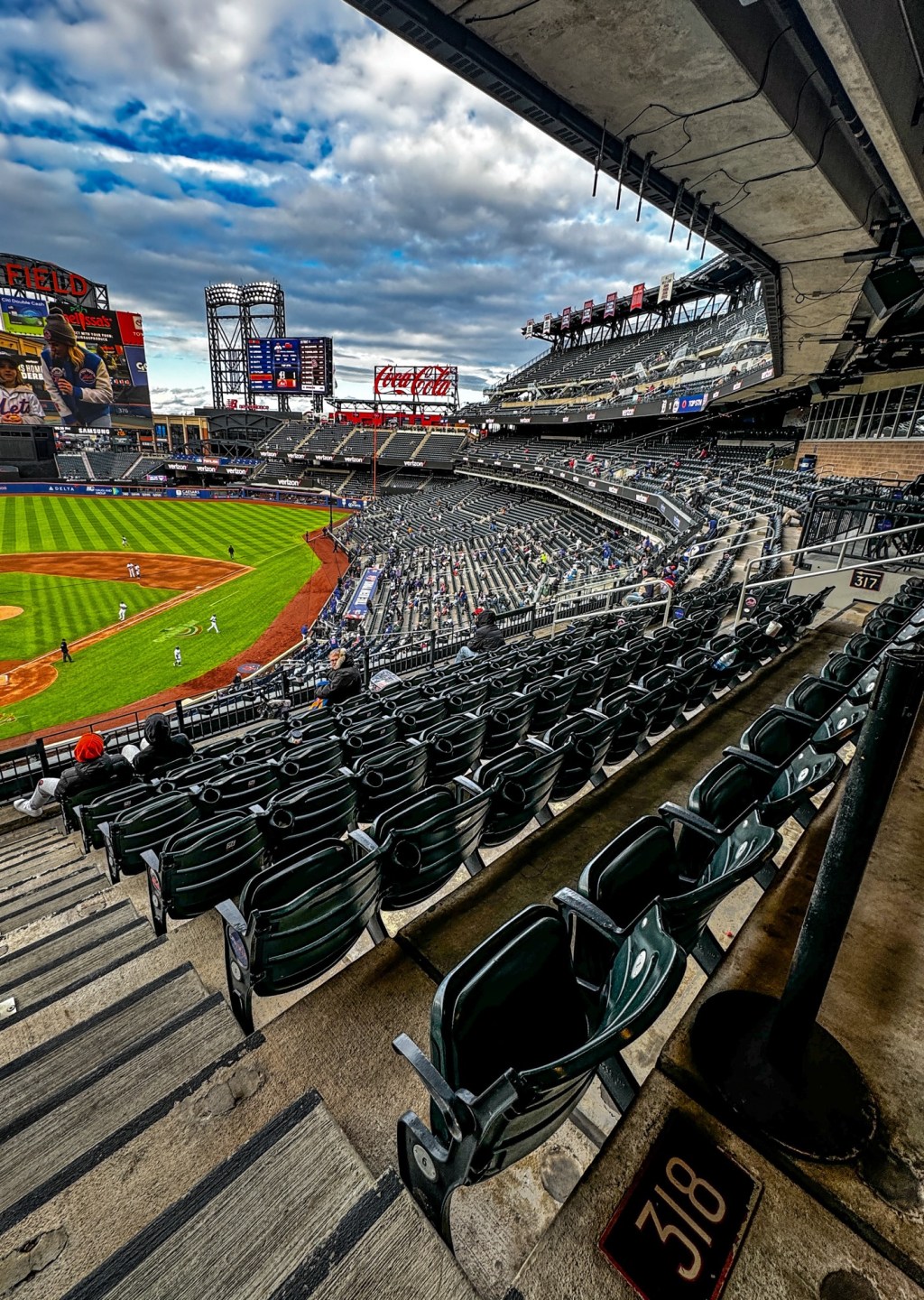
Canada Goose shields from cold and wind. Bud and others are remembered. Rhys returns and trouble brews. Benches, bullpens empty. A long ball that clanked off of the wall, but it was only one.
This blog has been a place for me to share my observations about similarities between two subjects about which I am passionate: classical music and baseball. Because the sport I love and write about is a team sport, my analogies have tended to center around what it means to perform as an individual on a team—a baseball team or an orchestra—at the professional level.
I was fascinated, then, to read the personal observations about similarities between classical music and sports by none other than our Music Director at the Metropolitan Opera, Yannick Nézet-Séguin!
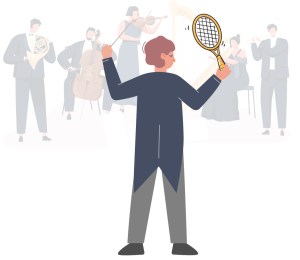
I found what he had to say particularly interesting because his basis of comparison was not to a team sport but to a solo sport: professional tennis.
I particularly liked how he suggested that an appreciation of sports in general and tennis in particular could be seen as a “gateway” to enjoying classical music:
Classical music and opera in general is [like professional tennis] also something that you can just sit and watch people really sweat and give their all at the service of something that’s very beautiful. It’s a very human experience when you see people giving their all on their instruments and sweating it.
It’s maybe what can draw sports fans who probably sometimes think, Oh, I love sports. I don’t really like art. But maybe they forget that great art, the way we do it, is also witnessing a human reaching the peak of or outdoing themselves and just going beyond their human limits.
Yannick Nézet-Séguin
I read Maestro Nézet-Séguin’s observations in a thought-provoking interview he recently gave to Sports illustrated. You can read the interview in its entirety here.
The interview was written in anticipation of an appearance by our Music Director, some of my MET Orchestra colleagues, and baritone Will Liverman at Arthur Ashe Stadium. The musicians provided a musical prelude to the Men’s Finals of the U.S. Open last Sunday, September 10th.
Garry Spector at Citi Field on one of two occasions that he got to throw out the ceremonial pitch prior to a Mets game.
Yogi Berra’s famous adage is applicable to many pursuits in life. I would like to think that for me, learning ain’t over until my departure from this earth.
My husband, Garry Spector, has a PhD in chemistry from Columbia University. He possesses an encyclopedic knowledge of all things baseball, particularly the sixty-year history of our beloved Mets franchise. He also knows far more about classical music, including opera, than many of us in the industry itself. His knowledge and remembrance of historical events of significance and their respective dates is positively intimidating.
But what my husband doesn’t possess is vanity. He knows so much about all of these subjects because his fascination with them has fueled a lifetime of voracious reading and regular attendance at baseball games, concerts, and operas.
Garry frequently shares anecdotes, facts, and trivia when either the day’s date or a current event triggers his memory of a related event in history. This he does, not to flaunt his vast knowledge, but because of his genuine enthusiasm for the subject at hand.
I would never think nor try to compete with Garry’s comprehensive knowledge, but in our twenty-seven years of marriage, he has seemed delighted to hear my own stories and anecdotes about classical music from my thirty-five years working as a professional musician. He particularly delights in hearing many of the stories I have from my thirty years as a member of the Metropolitan Opera Orchestra.
If Garry has any “blind spots,” he readily admits that there are gaps in his knowledge, particularly of popular culture. It was particularly delightful to be able to fill in one of those “gaps” for him involving baseball—a subject about which I am a novice compared to him.
A life-long follower of the Mets, Garry grew up listening to the radio voice of the late Bob Murphy. Early on in our shared baseball life, I learned that it was Murphy’s voice decrying the famous “It gets by Buckner!” call that is near and dear to Mets fans of all ages. He has casually mentioned some of Murphy’s delightful terminology.
When the subject of a doubleheader came up some years ago, Garry admitted that that was one of Murphy’s expressions that he had never understood.
In single admission doubleheaders, the second game follows shortly after the first game has concluded. On other occasions, like today at Citi Field for example, two separate games with separate admissions are scheduled. This is called a day-night doubleheader—what Bob Murphy referred to as a “Cole Porter affair.”
How thrilling it was for me to be able to fill this infinitesimal gap in his broad and thorough knowledge of all things baseball!
I explained that one of Cole Porter’s most famous tunes was “Night and Day.”
Lady Gaga and Tony Bennett are two of countless artists who have sung and recorded this jazz standard since Cole Porter wrote it in 1932.
There have been only a few times like this where my knowledge of popular culture has served to add meaning or perspective on either baseball or opera. On road trips to see the Mets, we have been at several ballparks where an organist has played the players’ walkup music. There have been times where I smile, knowing the words to the melody the organist plays for specific players and how they serve as a musical commentary to either their name or appearance. These “inside jokes” are mostly lost on Garry.
It doesn’t happen often, but on those occasions when I can “teach” Garry something that he doesn’t know related to baseball, we both enjoy it. As far as we both are concerned, we “ain’t over” learning new things until “it’s over.”
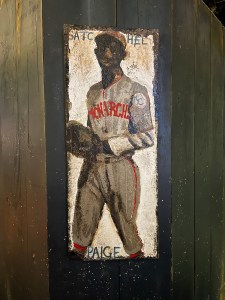
An artist’ rendition of Satchel Paige Negro Leagues Baseball Museum
I watched with interest as Pete Alonso crushed the competition in the 2021 All-Star Game Home Run Derby earlier this month in Denver, Colorado. As a Met fan, I loved it of course, but it had me thinking about seemingly unrelated things: a book I read as an undergraduate and the legendary pitcher Satchel Paige.
I couldn’t take my eyes off of Alonso, realizing that I was witnessing a confident athlete, trusting himself completely, and fully in his “zone.” As a performer, I have experienced that feeling too. But I’ve also know the paralyzing feeling of “stage fright.” I’m guessing Pete has too.
Many of my colleagues are prescribed beta-blockers for controlling the physical manifestations of “nerves” for high profile performances and auditions. I have never taken medication, but I have been given advice for combatting this performance impediment from teachers. I have also developed my own techniques to keep the “negative” effects of adrenaline to a minimum.
A book that was widely read by music performance students of my generation was The Inner Game of Tennis by W. Timothy Gallwey, first published in 1974. Author Barry Green later came out with a “version” for musicians: The Inner Game of Music was released in 1986 while I was in graduate school. But music students in the early 1980s had little difficulty reading The Inner Game of Tennis and “translating” the advice within to instrumental performance applications all on our own.
The basic premise of the book is that if one trains over and over to the point where he or she can consistently perform a particular physical feat, one should then trust the body to do what it is well-trained to do and not let self-critical thoughts subvert the performance. Scientists know that the left hemisphere of the brain controls analytical, critical thinking. Gallwey’s book suggests that, allowed to take over the mental part of the game, these left-brain “corrections” can sabotage one’s performance. This can manifest itself by shallow breathing, a racing heart beat, muscle tension, lack of confidence, increased perspiration, sweaty palms, or just plan underperforming.
Examples of negative left-brain messages might be:
“Don’t forget to exaggerate the follow-through on your backhand!”
“Don’t rush that upcoming passage with all of those sixteenth notes!”
”Don’t rush your serve!”
”I’m worried I’m going to run out of breath before I get to the end of this passage!”
”My opponent has won so many more big matches than me. How can I possibly beat her?”
”My accompanist said that so-and-so is in the audience tonight.”
The book goes on to suggest ways of silencing, or at least turning down the volume of those negative voices. This is the crux of the ”inner game.”
Described in this book and other places is the feeling of “zen” when a performer or athlete is in “the zone”: when he or she is hyper-focused to such an extent that he or she experiences “flow.” When in this state, one is oblivious to external factors: crowd noise, coughing in the audience, one’s own perspiration, even one’s own physical discomfort or pain. He or she has successfully “turned off”—or kept in check—the analytical left-brain’s advice/doubts/caution that can work to hinder his or her performance.
Or perhaps, I thought as I watched him, Pete Alonso was channeling the great Satchel Paige.
What I observed in Pete Alonso’s Home Run Derby spectacle was someone in complete “flow,” confident in his physical abilities and seemingly oblivious to any negative thoughts or any other distractions that might make him “press” or otherwise get in the way of the batting skills that he has worked on and at which he has excelled for many years.
He put complete trust in those skills to serve him as they always have. And they did.
I was amused, as were many others, to see Pete keeping himself loose by unapologetically nodding in time–like a bobble-head–to the sounds of the playlist he had curated for his Derby at-bats, even dancing at times. Perhaps his physical movements served to perpetuate the “groove” he was obviously in and continuing to win at his “inner game” as well. Or perhaps, I thought as I watched him, Pete Alonso was channeling the great Satchel Paige.
A promotional poster featuring Paige’s distinctive windup Negro Leagues Baseball Museum
Last month I had an inspiring road trip with my husband to various places in the Midwest. Visiting the Negro Leagues Baseball Museum had been on my Bucket List for some time, so while we were in Kansas City, we made the pilgrimage there. I would have loved to have spent far longer there, but the size and spacing of the crowds inside the museum–during this period of encouraged social distancing–made me slightly nervous, preventing me from dwelling longer in front of the outstanding displays.
The great pitcher Satchel Paige was certainly well represented in the museum. It was fascinating seeing so many photos of him and the timeline of his career. He was still playing Major League Baseball when he was fifty-nine years old! Thanks to my helpful husband, during the course of our visit, I also learned what “barnstorming” was.
Barnstorming tours provided the perfect stage for Satchel’s showmanship. His gravity-defying windup was eye-catching for sure, but the entertainment didn’t stop there. He often took an exaggerated leisurely stroll to the mound, clowned around, and engaged in trash talk. And Satchel had the “stuff” to back up his swagger.
On the barnstorming tours, one of Satchel’s favorite tricks when he was on the mound was to bring in the outfielders and have the infielders behind him take a seat while he proceeded to strike out the side!
There was a single specific stunt that Satchel was apparently particularly proud of:
According to Paige, an even more famous stunt came during a Negro League World Series game in 1942, when he intentionally walked two batters so that he could face power hitter Josh Gibson with the bases loaded. After taunting Gibson and warning him about where he intended to place each throw, Paige struck him out in three pitches.
This guy would have made the most egregious bat-flipper, swag-chain-wearing, homer-horse-riding ballplayer look like a rank amateur.
I could easily see a bit of Satchel Paige’s theatrical, fun-loving, overly confident barnstorming days in Pete Alonso’s Derby “styling.”
Gregory Siff designed these bats for New York Met Pete Alonso to defend his title in the Home Run Derby. Photo courtesy of Pete Alonso, Lfgm Shop.
You could also say that Alonso was channeling Satchel in the personalization of his weaponry. He commissioned artist Gregory Siff to create bats for him just for the occasion, each one differing slightly from the other. In interviews and during the broadcast of the Derby, Alonso detailed each bat’s unique story and features.
Like Pete, Satchel’s larger-than-life persona extended to his “tools.”
According to Andrews,
Paige typically relied on his scorching fastball to strike out batters, but he gave the pitch a litany of different names including ‘Bat Dodger,’ ‘Thoughtful Stuff’ and ‘Long Tom.’ He was particularly found [sic] of hurling the ‘Bee-Ball’—a pitch with so much zip that it supposedly buzzed like a bee as it sailed into the catcher’s mitt. As the years passed and his power faded, he fell back on an arsenal of trick pitches such as the ‘Midnight Creeper,’ the ‘Wobbly Ball’ and the ‘Whipsy-Dipsy-Do.’ One of his favorites was the ‘Hesitation Pitch,’ which saw him pause mid-delivery to fool batters into swinging early. The throw usually worked like a charm, but Major League managers complained about it so much that it was eventually made illegal.
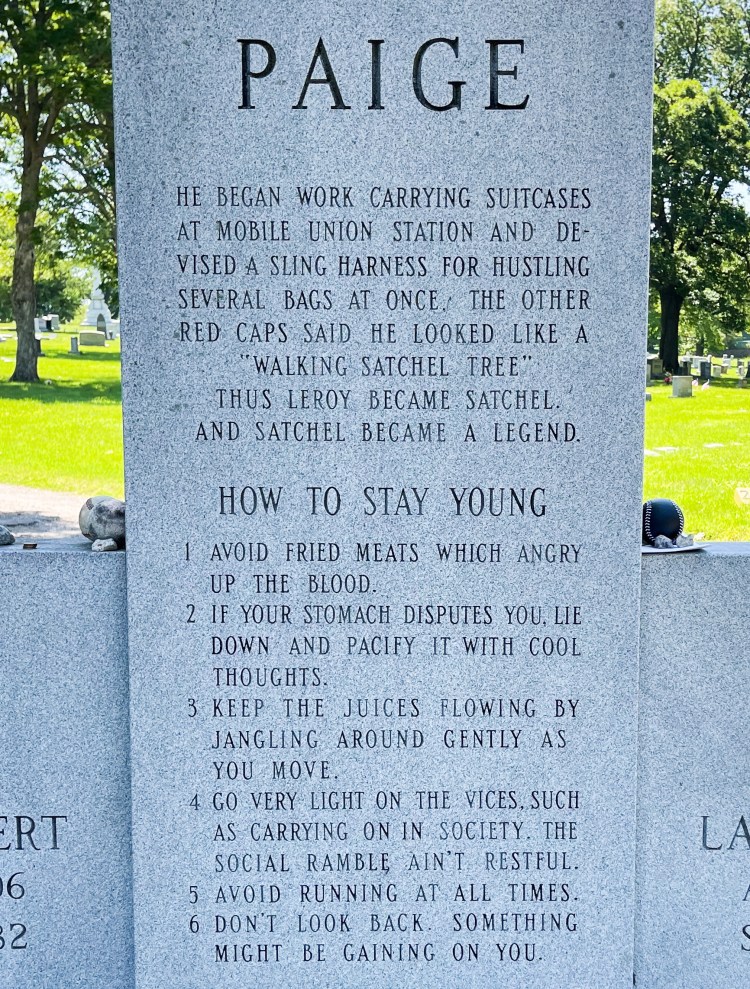
Perhaps you’ve read somewhere Paige’s advice for “staying young?” It has been reprinted elsewhere, but it is famously etched into his headstone. So while we were in town, we went to Forest Hills Memorial Park Cemetery to find Satchel’s final resting place.
Having recently seen Satchel’s tips, when I saw Pete Alonso’s dance moves—presumably to keep himself loose during the Derby—I instantly thought of Satchel’s third piece of wisdom.
Alonso may have referred to his own moves differently, but couldn’t one argue that Pete was “jangling around gently” as he moved? And is it a stretch to say that by doing so he was keeping his “juices flowing?”
But just maybe Paige “jangled gently” to avoid jangled nerves.
Were Satchel’s “juices” a euphemism for blood—meaning to keep one’s circulation flowing?
Perhaps when Satchel got on base and took a lead off the bag, he “jangled gently” in order to avoid being flat-footed. Jangling could have kept him light on his feet, enabling him to spring, cat-like, back to the base in order to avoid getting tagged out or allowing him to get a good jump when attempting to steal a base. In that case, I saw plenty of jangling from former Met José Reyes.
But just maybe Paige “jangled gently” to avoid jangled nerves.
Maybe keeping his “juices flowing” was a description of Satchel’s strategy for playing his “inner game,” listening to his own inner rhythms, keeping his athletic juices AND positive thoughts “flowing.”
Could this be Satchel putting Rule No.2 to use? Pacifying his mind “with cool thoughts?”
St. Louis Browns pitcher Leroy “Satchel” Paige relaxing in his bullpen rocking chair reading a newspaper during a game, ca. 1952. Photo Credit: Missouri History Museum
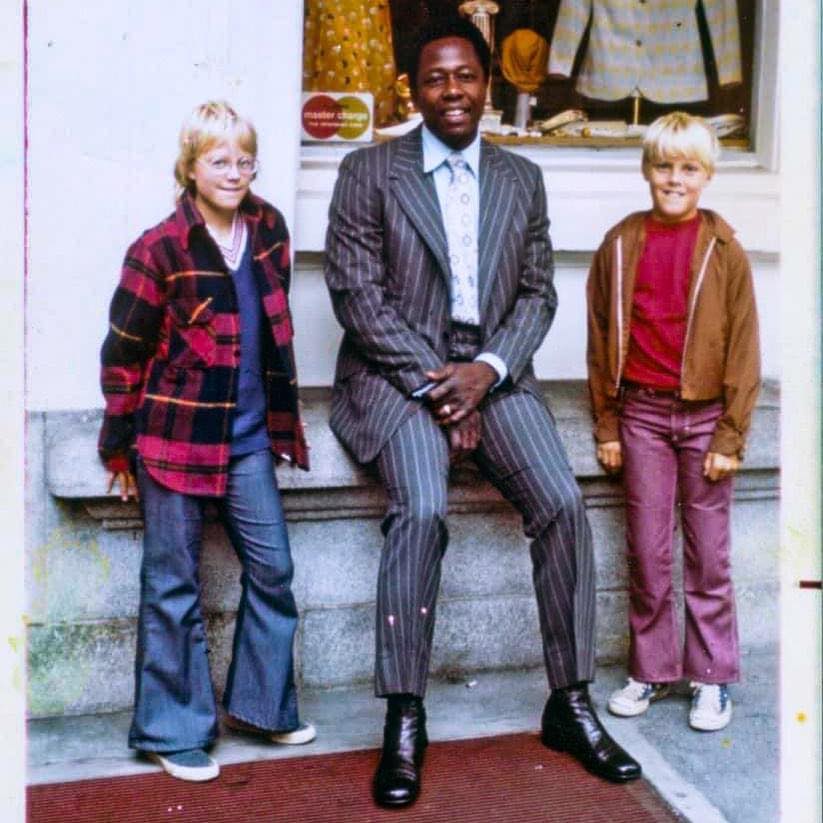
The author and her brother with Hank Aaron–a chance encounter outside his San Francisco Hotel, ca. 1973.
Anyone who thinks that Jackie Robinson broke Major League Baseball’s color barrier and acceptance for other ballplayers of color followed closely behind is, of course, sadly mistaken. Baseball is full of disgusting tales of prejudice and inequalities persistent well beyond Robinson’s career.
As much as I have enjoyed reading all of the tributes written in homage to the late Hank Aaron, I feel it’s imperative that his accomplishments be remembered within the context they were achieved.
Hank Aaron was no stranger to white rage throughout his career, but the volume was turned up tremendously as he grew closer to breaking Babe Ruth’s home run record. In various autobiographies and biographies and in published interviews he was unambiguous about the pain and suffering he and his family had suffered because of prevalent racist attitudes:
“April 8, 1974, really led up to turning me off on baseball. It really made me see for the first time a clear picture of what this country is about. My kids had to live like they were in prison because of kidnap threats, and I had to live like a pig in a slaughter camp. I had to duck. I had to go out the back door of the ball parks. I had to have a police escort with me all the time. I was getting threatening letters every single day. All of these things have put a bad taste in my mouth, and it won’t go away. “
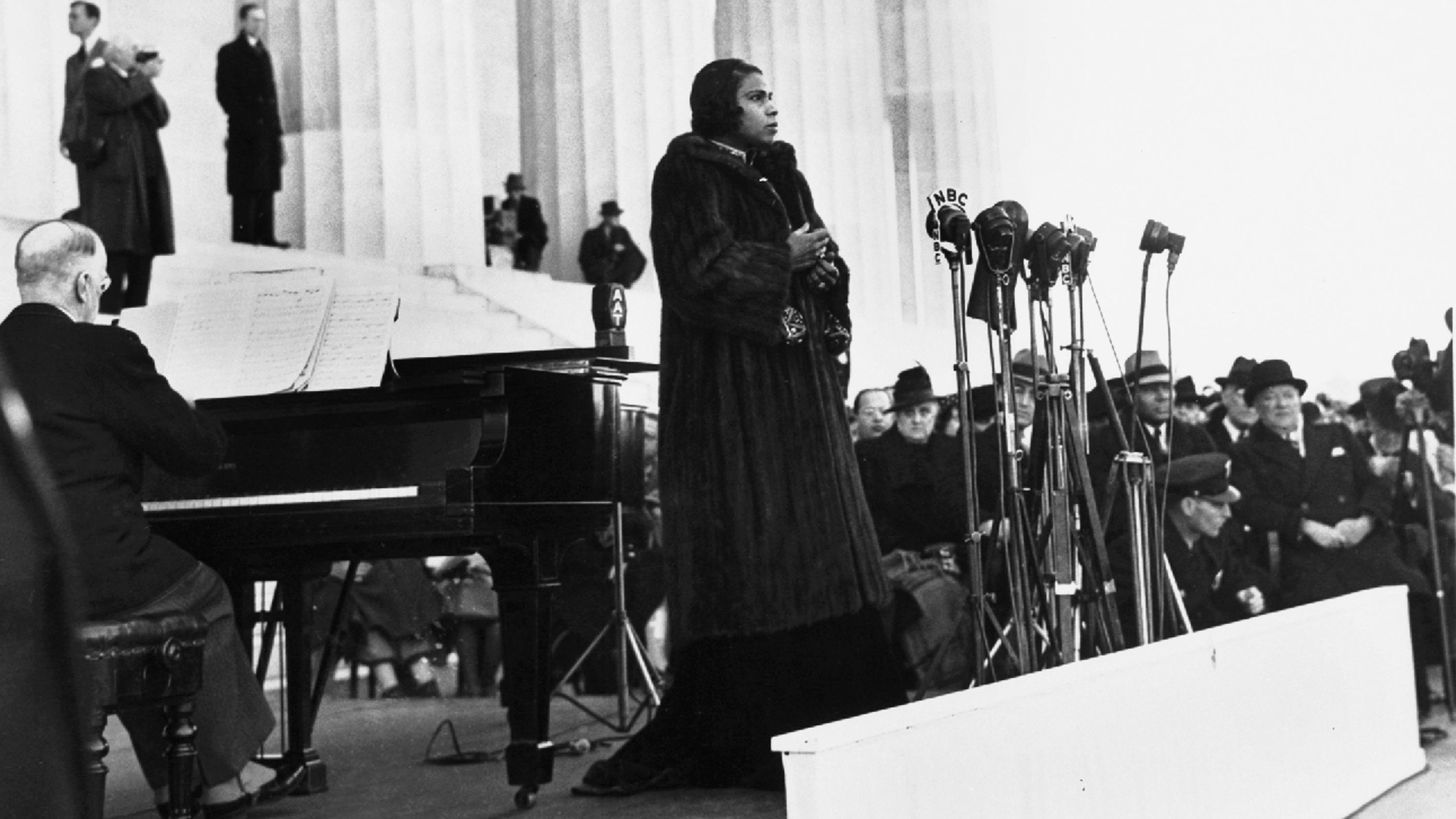
The contralto Marion Anderson was arguably the “Jackie Robinson” of the opera world. In 1955, she became the first Black singer to sing a solo role at the Metropolitan Opera. But perhaps more well-known than that debut was her appearance singing at the Lincoln Memorial in Washington, D.C., in 1939 for a crowd of 75,000. She had been denied the venue of Constitutional Hall in Washington by the DAR who cited a “white-artist-only” clause in their contractual agreements for appearances in the building which they owned.
Marian Anderson on the steps of the Lincoln Memorial – April 9, 1939
Like athletes of color, black singers have continued to experience both overt and subtle racism long after Anderson’s MET debut. For some, that has kept them from the opera stage. For others who did have careers, one has to wonder what they endured to get there and what they suffered to remain in the spotlight. Also, was the color of their skin perhaps a reason why some of them are not more widely known? And what voices of perhaps similar beauty and musical excellence were never recognized nor heard?
The previous year saw public outcry over the murder of George Floyd, nation-wide peaceful protests in support of Black Lives Matter, and organizations–including Major League Baseball and the Metropolitan Opera–taking a good hard look at ways that they have been a part of the problem in persistent racism in this country. We have also seen the election of the first Black Senator from Georgia–all very positive events.
But the past year also saw a tone-deaf administration abandon its job of dealing with a pandemic that has been found to disproportionally affect Americans of color. We have seen blatant voter suppression and attempted disenfranchisement of lawful voters from urban, i.e., predominately Black districts. We had no sooner turned the calendar than the entire world witnessed an attempted coup against the Legislative branch of our government perpetrated by domestic terrorists, a number of whom openly espoused racist and antisemitic rhetoric and slogans and who were aided and abetted by others with the same white supremacy proclivities and agenda.
Until this country has a reckoning with its racist past in some sort of meaningful way, I fear that it will ever be this way: three steps forward, two steps back. And I don’t have a lot of confidence in any such national awakening happening, I’ll be honest. But there is one thing about which I am certain: there will be Black Americans who rise to the top of their disciplines and fields despite the senseless and disgusting impediment of racism that is put in their paths.
But, I too have a dream: that one day we the public will be able to see all of the rich Black talent–in sports, in classical music, and in all other arts and sciences and human endeavors. There are certainly those figures who have excelled in spite of their detractors. But imagine those whose talents that we never were allowed to enjoy and experience simply because the hate and cruelty were too great for those individuals to persevere in their pursuit of greatness?
It’s not an understatement to say that I went into a depressive funk following the event of January 6 2021. But, while marking Martin Luther King, Jr.’s work and legacy about a week later, I tried to keep in mind his perseverance and the phrase he often included in his sermons:
“The arc of the moral universe is long, but it bends toward justice.“
If you watched the Inaugural ceremony, perhaps you were inspired by the animated reading and thought-provoking words of Amanda Gorman, National Youth Poet Laureate. I certainly was.
I’ve tried to retain the spirit of optimism that is so deeply embedded in her poem “The Hill We Climb,” an excert from which I include below:
And so we lift our gazes not to what stands between us, but what stands before us. We close the divide because we know, to put our future first, we must first put our differences aside. We lay down our arms so we can reach out our arms to one another. We seek harm to none and harmony for all. Let the globe, if nothing else, say this is true, that even as we grieved, we grew, that even as we hurt, we hoped, that even as we tired, we tried, that we’ll forever be tied together, victorious. Not because we will never again know defeat, but because we will never again sow division.
Ms. Gorman penned these words in response to the events of January 6th. Perhaps I would do well to look to her and Millenials like her–those who remain positive in the face of their generation’s less than bright immediate future and who tend toward idealism–for inspiration.



























 Perfect Pitch
You must be logged in to post a comment.